The Cyber Security Crash Course for Small Businesses: Stop Making It Easy for Hackers
By ERMW Team
Thursday, June 18, 2026
There is a dangerous misconception among small business owners that they are simply "too small" to be a target. In reality, attackers view local enterprises as low-hanging fruit. They know that smaller operations often lack the enterprise-grade security budgets of massive corporations, yet still hold incredibly valuable data.
Whether your daily operations involve tracking inventory for a local produce shop, handling confidential bookkeeping for an insurance firm, managing massive client files for an independent video production company, or coordinating complex website migrations, your data is a goldmine. This crash course cuts through the technical jargon to give you the practical, ground-level defenses you need to protect your livelihood.
Understand Your Assets and Assess the Risk
Before you can build a defense, you have to know exactly what you are defending. Cyber risk essentially boils down to a simple equation.
Risk = Threat x Vulnerability x Impact. You cannot always control the threats that exist on the internet, but by reducing your vulnerabilities, you severely limit the potential impact on your business.
Take a visual inventory of your digital and physical assets. Map out exactly where your sensitive information lives and who has access to it.
Financial Records: Bookkeeping ledgers, payroll data, and banking credentials require the highest level of strict access control.
Client Data and Intellectual Property: Unreleased video cuts hosted on collaboration platforms like Frame.io, raw footage, and proprietary SEO migration strategies are highly valuable assets that need encryption.
High-Value Hardware: Physical security matters just as much as digital security. High-performance computing rigs featuring high-end processors and graphics cards used for heavy 3D rendering or video processing are prime targets for physical theft.
Operational Accounts: Administrator access to automation workflows (like Make), visual management boards (like Trello), and your website's backend must be locked down to prevent a localized breach from spreading across your entire operation.
The Core Defenses: Your Action Plan
You do not need an entire IT department to drastically improve your security posture. Implementing a few non-negotiable protocols will filter out the vast majority of automated attacks and opportunistic hackers.
Enforce Multi-Factor Authentication (MFA): Passwords alone are no longer sufficient. Require MFA for every single application your business uses, especially for cloud storage, email, and financial software.
Implement Role-Based Access: A freelance graphic designer does not need access to the company's bookkeeping software. Limit employee and contractor access strictly to the systems they need to complete their specific jobs.
Follow the 3-2-1 Backup Rule: Keep three total copies of your data, on two different mediums, with one copy stored off-site or securely in the cloud. If a ransomware attack locks down your primary editing machine, a disconnected external backup is your only lifeline.
Secure Your Physical Workspace: Treat your physical office space in the local community with the same rigor as your digital space. Use surge protectors for expensive workstations, lock doors, and never leave sensitive hard drives sitting on a desk.
Automate Software Updates: Hackers actively exploit known flaws in outdated software. Turn on automatic updates for your operating systems, video editing software, web browsers, and firewall devices.
Upgrading Your Security Arsenal
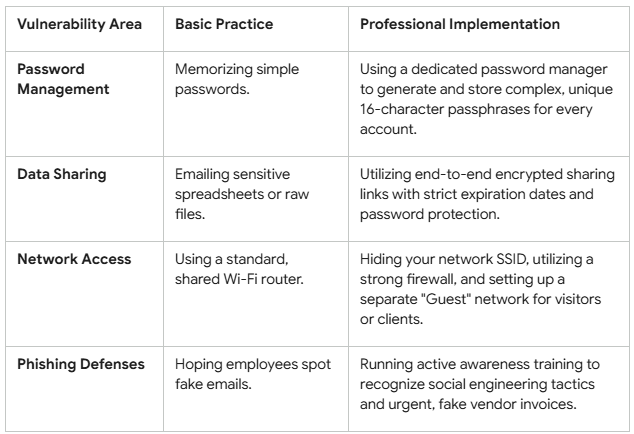
Transitioning from basic awareness to active defense requires standardizing your tools. Here is a breakdown of how to practically apply security concepts to daily business tasks.
Prepare for the Worst
Even the best defenses can be breached. Having an incident response plan ensures you aren't making critical decisions in a state of panic.
Know exactly who to call if you suspect a breach. Have a protocol for disconnecting infected machines from your network immediately to stop the spread. Finally, maintain transparent communication; if client data or sensitive migration databases are compromised, you must have a clear, honest strategy for informing the affected parties.
Cyber security is not a one-time project you can check off a list; it is an ongoing operational habit. By taking these practical steps, you protect your hard work, your clients, and your community's trust from the digital threats outside your door.
Here are some recommended platforms, adapted for businesses of any size and updated with direct links so you can easily integrate them into your team's training plans.
Whether you are onboarding a new hire, upskilling an IT department, or looking to understand the fundamentals of corporate network defense yourself, these platforms offer scalable, high-quality training.
CISA (Cybersecurity and Infrastructure Security Agency)
Best for: Official guidelines, threat alerts, and baseline business frameworks.
Why it matters: As a US government agency, CISA provides the gold standard for free, actionable security toolkits. Their resources scale from simple employee awareness fact sheets to comprehensive incident response plans, making it the perfect starting point for establishing organizational security policies.
SANS Institute - Free Training & Resources
Best for: Foundational security architecture and networking principles.
Why it matters: SANS is one of the most respected training organizations in the cybersecurity industry. Their free resources and foundational courses (which replaced their Cyber Aces program) break down how operating systems, networks, and system administration actually function, giving your team the structural knowledge needed to build resilient defenses.
TryHackMe
Best for: Hands-on, interactive attack and defense simulations.
Why it matters: TryHackMe gamifies the learning process. Instead of just watching videos, your team can spin up virtual machines directly in their web browsers to see exactly how vulnerabilities are exploited and how to patch them. It features dedicated paths for "Cyber Defense" and "Pre-Security" that are excellent for practical, lab-based upskilling.
Cybrary
Best for: Role-based video courses and certification preparation.
Why it matters: Cybrary operates like a streaming service for IT and cybersecurity training. It offers an extensive catalog of video courses designed for specific job roles (like network administrator or security analyst) and provides rigorous preparation for industry-standard certifications such as CompTIA Security+ and CISSP.
NIST Computer Security Resource Center (CSRC)
Best for: Enterprise compliance, advanced frameworks, and policy architecture.
Why it matters: The National Institute of Standards and Technology (NIST) Cybersecurity Framework is the benchmark for enterprise-level defense. Exploring their resource center is essential for businesses that need to scale their security posture, meet strict compliance regulations, or handle highly sensitive identity verification and data environments.