The 101 of Robotics Learning
By ERMW Team
Thursday, January 1, 2026
Robotics is not a single discipline; it is an exhilarating intersection of mechanical engineering, electrical engineering, and computer science. For beginners, this interdisciplinary nature can feel overwhelming. However, by breaking the field down into its core functional pillars, anyone can develop a robust pathway into the world of autonomous systems.
This in-depth guide provides the fundamentals—the "101"—needed to start your journey in robotics learning.
The Foundational Trinity: Hardware, Electronics, and Code
A robot, whether an industrial arm or a mobile rover, can be understood through three interdependent components that serve as its body, nervous system, and brain.
1. Mechanics (The Body and Muscles)
This is the physical structure of the robot—the hardware that executes motion.
Core Concepts:
Kinematics: The study of motion without considering the forces that cause it. You must understand how the joints and links of an arm relate to the final position and orientation of the end-effector.
Dynamics: The study of forces, torques, weight, and resistance that affect a robot’s movement. Essential for calculating the motor power required to lift a specific payload.
Design & Structure: Choosing appropriate materials, ensuring stability (center of gravity), and designing manipulators (arms) and locomotion systems (wheels/legs).
2. Electrical Systems (The Nervous System)
This involves the power sources, circuits, actuators, and sensors that enable physical interaction and perception.
Core Components:
Actuators (Motors): The "muscles" that convert electrical energy into motion (e.g., DC motors, stepper motors, servo systems).
Sensors: The "eyes and ears" that perceive the environment (e.g., encoders, proximity sensors, cameras, LiDAR).
Control Boards: Microcontrollers (like Arduino or Raspberry Pi) or PLCs (Programmable Logic Controllers) that run the low-level instructions.
3. Control & Programming (The Brain and Logic)
This is the software that dictates how the robot behaves—the high-level intelligence and logical decision-making.
Core Concepts:
Algorithms: The set of step-by-step instructions (e.g., sequential control flow, iteration, conditional statements).
Control Theory: The mathematical framework for regulating a system. A primary tool here is the PID Controller (Proportional-Integral-Derivative), used to minimize the error between a desired position (setpoint) and the robot's actual position.
Programming Languages:Python (excellent for high-level logic, AI, and planning) and C/C++ (essential for low-level, real-time control on microcontrollers).
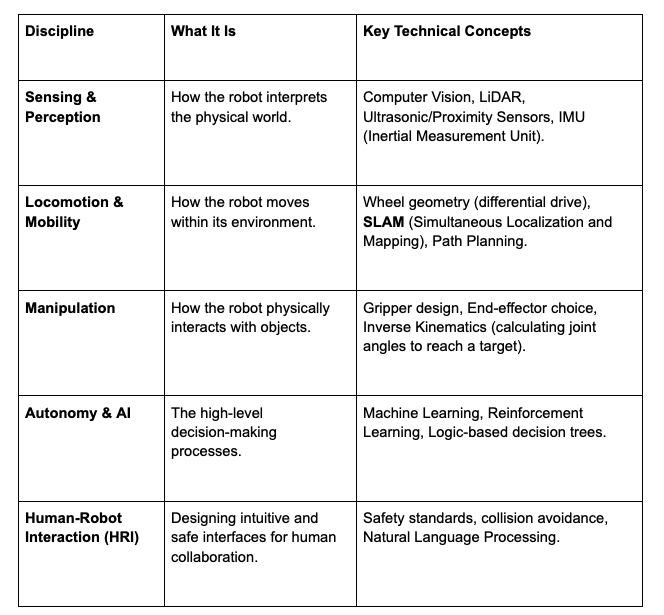
The Five Functional Disciplines of a Robot
When systems are combined, a robot performs specific functions. Introductory robotics focuses on these five key areas:
The Essential Toolkit for Aspiring Roboticists
Success in robotics requires a strong foundation in underlying technical disciplines and fluency in the tools used by professionals.
Required Foundational Skills
Mathematics & Physics: Essential for analyzing robot motion, calculating forces, and designing stable systems. Calculus, Linear Algebra, and Applied Physics (especially mechanics) are non-negotiable.
Computer Science: Beyond coding syntax, you need to understand data structures, algorithms, and embedded programming (coding that runs directly on hardware).
Problem-Solving: Robotics is complex; systems often fail in unexpected ways. Persistence and the ability to break down a large problem into small, debuggable segments are critical.
Industry Standard Tools and Platforms
ROS (Robot Operating System): The industry-standard middleware. It is not an OS in the traditional sense, but a collection of software frameworks for robot software development, enabling components (like a camera driver, motor controller, and navigation algorithm) to communicate easily.
Simulation Software: Platforms like Gazebo (often used with ROS), MATLAB/Simulink, or Webots allow you to test your code and design changes in a virtual environment before risking expensive physical hardware.
CAD Software: Tools like SolidWorks or Fusion 360 are necessary for creating physical designs (drawings for 3D printing or manufacturing) of robot components.
Microcontroller Platforms: Starting with low-cost platforms like Arduino or Raspberry Pi allows for hands-on experience with motor control, sensor interfacing, and basic embedded programming.
Getting Started: Your Robotics Learning Pathway
The best way to learn robotics is through practical experience.
Choose a Project Platform: Start with an accessible platform like an Arduino-based mobile robot kit (e.g., a simple line-follower) or LEGO MindStorms/VEX. This provides the immediate gratification of seeing code translate into physical action.
Focus on One Pillar: Don't try to master all three foundations simultaneously.
Start with Control: Master basic motion control (making a motor spin at a specific speed) before tackling complex navigation.
Then move to Perception: Learn to read data from a single sensor (e.g., an ultrasonic distance sensor).
Learn ROS: Once you have a handle on basic programming and motor control, transition to ROS. This forces you to think systematically about communication between different software nodes—the essence of modern robotics.
Practice Kinematics: Work through the mathematical problems of forward and inverse kinematics for a simple two or three-joint robotic arm. Understanding this math is the gateway to precise manipulation.
The path to robotics mastery is continuous learning. By focusing on the interplay between the physical and the digital, you build the core skills necessary to engineer the autonomous future.
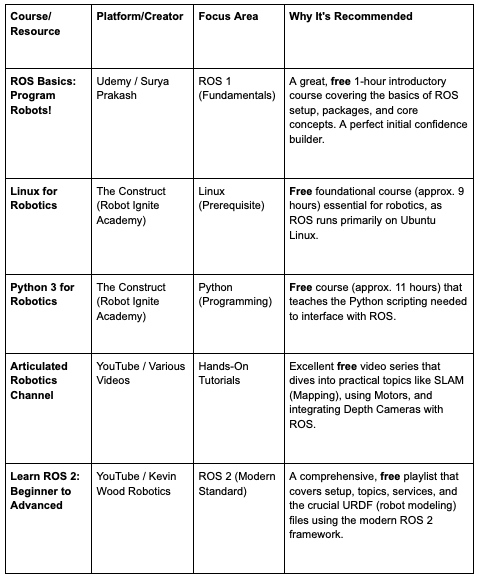
Essential Resources for Robotics Beginners
I. Free Online Courses & Video Series (ROS Focus)
These resources are ideal for learning the fundamental concepts of the Robot Operating System (ROS), often using Python or C++ on free-to-use simulators like Gazebo.
Recommended Textbooks for Learning Kinematics & Theory
While robotics textbooks can be mathematically rigorous, the following are highly respected and widely used in both academic and industry settings. They are the best sources for mastering the Kinematics required for robot manipulation.
1. The Definitive Foundation (University Level)
Title: Modern Robotics: Mechanics, Planning, and Control
Author(s): Kevin M. Lynch and Frank C. Park
Focus: Core Kinematics (Forward & Inverse), Dynamics, Motion Planning, and Control.
Why It's Recommended: It's considered the contemporary standard for robotics curricula. It takes a modern approach using tools like screw theory and provides free online video lectures (via Coursera Specialization) and often a free PDF of the textbook is available directly from the authors’ websites.
Title: Introduction to Robotics: Mechanics and Control
Author: John J. Craig
Focus: Classical Robotics, Denavit-Hartenberg (D-H) Parameters, Control Systems.
Why It's Recommended: This is a classic, time-tested text known for its clear, thorough explanation of manipulator kinematics. Many industry professionals learned from this book.
2. Accessible Theory & Primer
Title: The Robotics Primer
Author: Maja J. Mataric
Focus: Broad overview of robotics, from basic perception and locomotion to control architectures and AI.
Why It's Recommended: It is praised for its highly readable and conversational style, making it one of the best choices for high school students or beginners without a heavy calculus background who want a strong conceptual overview.
Title: Probabilistic Robotics
Author(s): Sebastian Thrun, Wolfram Burgard, Dieter Fox
Focus: Mobile Robotics, Perception, Localization, and Mapping (SLAM).
Why It's Recommended: While advanced, it is the foundational text for modern autonomous mobile robots. It explains the core concepts behind Kalman Filters and particle filters used in navigation and is often available as a free PDF online.