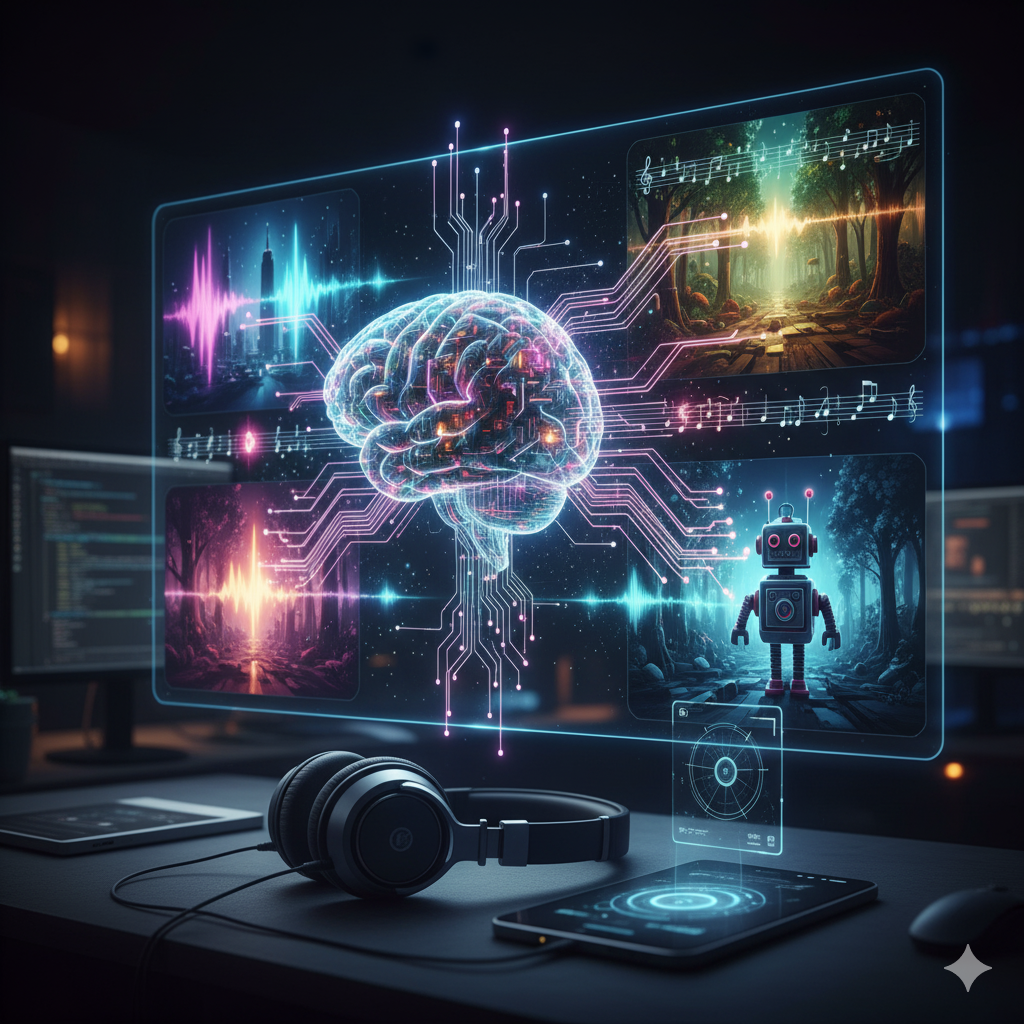
AI-Generated Music & Sound Design
By ERMW Team
Thursday, October 16, 2025; Updated January 6, 2026
AI-Generated Music & Sound Design: Unlocking a World of Sonic Possibilities
Music and sound design are the emotional foundation of any cinematic work. They have the power to elevate a video from good to truly unforgettable, yet securing high-quality, perfectly tailored audio has long been a major hurdle for independent filmmakers and content creators. The solution has arrived in the form of Artificial Intelligence, which is rapidly democratizing the sonic landscape. AI tools are no longer just for novelty; they are empowering creators to build custom, mood-perfect soundtracks and unique sound effects, even without a traditional musical background or a large budget.
Mood-Based Soundtracks: Music That Fits Your Vision Precisely
The era of sifting through thousands of generic stock music tracks is coming to an end. AI music platforms are built on complex algorithms and vast datasets of musical theory, allowing them to compose original pieces tailored precisely to a user's need.
Tailored Tunes and Instant Composition
Instead of searching for a "close enough" track, creators can now input simple, natural language prompts like "uplifting adventure with cinematic strings," "ominous sci-fi ambient synth, " or "1950s detective jazz piano." The AI interprets these moods, genres, and instrumental requests and instantly composes a custom, unique score. This breakthrough shifts the process from passive searching to active, collaborative creation.
Iteration, Refinement, and Dynamic Scoring
The real power lies in the ability to iterate and refine. Once a score is generated, the creator maintains control. You can adjust the tempo, swap out instrumentation (e.g., changing from a flute melody to a cello melody), or increase the intensity of the track simply by adjusting a slider or adding a text prompt.
Furthermore, some advanced platforms offer dynamic scoring. If you have a scene that transitions quickly from tension to relief, the AI can generate a track that flows seamlessly with those shifts, ensuring the music hits every emotional beat exactly when you need it.
Royalty-Free Relief and Licensing Simplicity
For budget projects and commercial content, licensing fees are a notorious headache. AI-generated music provides a clear solution. Because the AI is composing original music based on its training, the resulting tracks are typically offered with simple, royalty-free licenses. This eliminates the legal complexities and significant costs associated with licensing major commercial tracks or hiring a professional composer for every piece of background music.
Custom Sound Effects: Moving Beyond the Library
Sound effects (SFX) are the texture of the soundscape, but finding the perfect sound in a massive library is often a task of compromise. AI is solving this problem by enabling the creation of bespoke sounds.
Bespoke Sounds at Your Fingertips
Imagine needing a specific sound that doesn't exist: the sound of a "retro robot power-up in a dusty arcade" or the specific "ambience of an alien forest at dusk." By describing the sound you need, the AI generates unique, custom options. This eliminates the need to layer multiple library sounds or settle for a sound that's close, but not quite right.
The Perfect Fit vs. Foley Precision
AI is fantastic for creating unique sonic layers—ambience, futuristic whooshes, creature vocals, and abstract musical effects. However, for core foley work—the precise, synchronized sounds of character interaction (footsteps, door slams, keys jingling)—the nuanced precision and timing of professionally recorded SFX or live foley still often yield superior results. The best approach is to use AI to augment and layer your sound, not necessarily replace the fundamentals.
Understanding the Trade-Offs: Benefits and Limitations
While AI is a powerful accelerator in sound design, it's essential to understand its place in the creative process. It presents undeniable advantages in speed and accessibility, but it still has limitations when compared to human composition.
Key Benefits
The primary appeal of AI lies in its efficiency and cost-effectiveness:
Endless Exploration and Creative Velocity: AI can instantly generate variations and suggest musical directions (instrumentation, tempo changes, genre fusions) that a human might not have considered. This rapidly expands the sonic palette available to the filmmaker and allows for unparalleled creative exploration in a fraction of the time.
Cost-Effectiveness and Licensing Relief: For independent or budget-conscious projects, AI significantly reduces reliance on expensive, contracted composers or the complex, often costly licensing fees associated with commercial stock music. The simple, royalty-free nature of AI-generated tracks offers immediate financial and legal peace of mind.
Flexibility and Instant Iteration: The digital nature of AI composition allows for unprecedented flexibility. Filmmakers can tweak scores—adjusting the intensity, duration, or key—even late in the editing process. This instant iteration capability ensures the music can be perfectly tailored to match the final cut, saving days of back-and-forth revision time with a human composer.
Limitations to Keep in Mind
Despite its technical sophistication, AI has not yet mastered the nuances of human artistry:
Emotional Nuance and Depth: AI still struggles to match the complex, non-linear emotional expression and human intention found in top-tier, traditionally composed music. While AI can produce technically perfect scores, the subtle, deep emotional resonance and unique narrative voice of a masterful human composer remain difficult to replicate.
Aesthetic Homogeneity: Without sophisticated prompting, an AI can sometimes produce sounds that feel too polished, generic, or lack a distinct, memorable artistic signature. Relying too heavily on default settings can lead to music that perfectly fits the scene but fails to truly elevate or define it.
AI as Instrument, Not Artist: The tool requires direction. AI is a powerful instrument, but it is not a replacement for musical direction. A solid understanding of composition, rhythm, and the emotional power of musical mood is still essential for providing the effective prompts necessary to guide the AI and achieve an impactful, cinematic result.
In the end, AI acts as an instrument—the most powerful synthesizer and sample library a filmmaker has ever owned. It doesn't replace the need for creative direction, but it empowers creators of all levels to unlock sonic possibilities and make professional-sounding soundtracks attainable. Embrace it as the ultimate tool that expands your creative limits.
Useful Resources for Content Creators
One of the leading text-to-song AI generators. You can generate full, polished songs, including lyrics and vocals, from a simple text prompt.
Suno's main competitor, highly praised for its ability to create music with emotional, synthetic vocals and its iterative workflow for refining tracks.
Excellent for content creators who need custom, royalty-free background music for podcasts, videos, and apps, as it is known for generating high-quality tracks with no unwanted artifacts.
A royalty-free AI music generator designed specifically for video creators, which allows you to customize tracks and get licenses for commercial monetization.
A utility tool that uses AI for stem splitting, allowing you to separate vocals, instruments, drums, bass, etc., from a full track. This is useful for sound design and remixing.
Reader Suggestion
Submitted to us by a reader, Riverside is used to capture studio-quality remote audio with local recordings for each participant, background noise control, and simple in-browser editing.