Why Carpentry is the Unsung Hero of Film and Television
By ERMW Team
Thursday, December 4, 2025
Far from being a simple, rustic trade, carpentry is a dynamic and indispensable skill set in the world of film and television. It's the silent architect that builds the very world the audience sees, transforming flat designs into immersive, three-dimensional realities. The magic of cinema often relies on the masterful and often unseen work of the set construction team, where the carpenter is the foundational craftsman.
Where the Sawdust Flies: Carpentry's Role on Set
Carpentry skills are woven into the fabric of almost every physical production element. Here’s where you'll find the work happening:
Set Construction: This is the most visible area. Carpenters build the walls, floors, platforms, and stairways that form the structural core of any location that isn't shot on-site. These are built strong enough for actors and crew, yet designed to be easily modified, moved, or even destroyed for a scene.
Prop Fabrication: From a character's custom-built desk to a medieval chest, woodworkers are key prop makers. They bring designs to life, ensuring props are sturdy, safe, and match the historical or stylistic needs of the script.
Rigging for Camera and Lighting: Not everything on set is decorative. Carpenters, often working as part of the Grip and Electric departments, create custom wooden blocks, wedges, platforms, and supports to secure heavy cameras, create specialized dolly tracks, or mount lighting instruments in precise locations.
Scenic Carpentry: Especially prominent in studio work and theater, scenic flats and backdrops are large, lightweight wooden frames covered with fabric or hard materials, designed to be painted and create the illusion of a full environment.
From Hobby Bench to Hollywood Backlot: The Crossover
The skills needed on a film set are often born in a home workshop. If you enjoy woodworking as a hobby, you already have a head start for a career in production!
Furniture Making: The ability to craft strong, aesthetically pleasing pieces is directly applicable to creating hero props and set dressing.
Model-Building: Scale and precision are key in both model-building and miniature work for film, offering a seamless transition for those who enjoy detailed construction.
DIY Home Projects: If you're comfortable reading blueprints, framing a wall, or hanging drywall, you have the foundational knowledge that a Set Carpenter uses every day.
Film Roles for the Woodworking Pro
Your talents in the workshop can translate into several vital on-set titles:
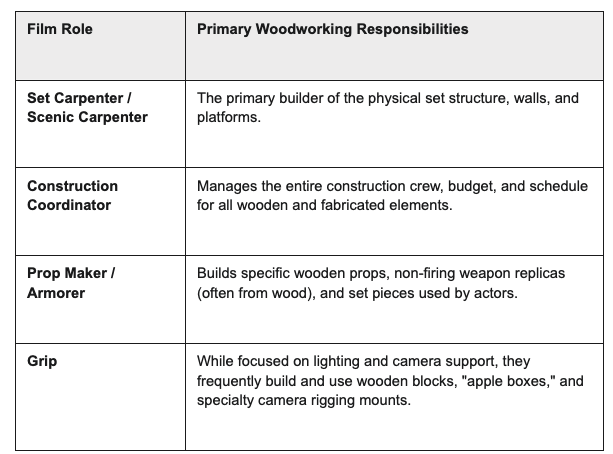
In an industry that demands precision, speed, and creative problem-solving, the ability to work with wood is not just useful—it's essential. So, the next time you marvel at a beautifully designed film environment, remember the skilled carpenters whose quiet work brought that world into existence.
The Indispensable Role of the Lead Carpenter (Key Grip)
While the entire construction team is vital, the Key Carpenter or Construction Coordinator often acts as a bridge between the designer and the execution. They manage the crew, budget, and schedule, ensuring the set is ready for the Gaffer (lighting chief) and the Grips (rigging experts) on time. Their decisions directly impact the production timeline and, ultimately, the final budget.
In an era where visual effects (VFX) are dominant, practical set construction remains crucial. A physical set provides the actors with a genuine environment, enhances the realism captured by the camera, and often proves more cost-effective and believable than entirely digitally created backdrops.
Ultimately, carpentry in film and television is the essential craft that turns a story idea into a tangible, touchable space. It's the foundation of the world-building process, proving that the oldest trades are often the most critical in creating the newest forms of cinematic magic.